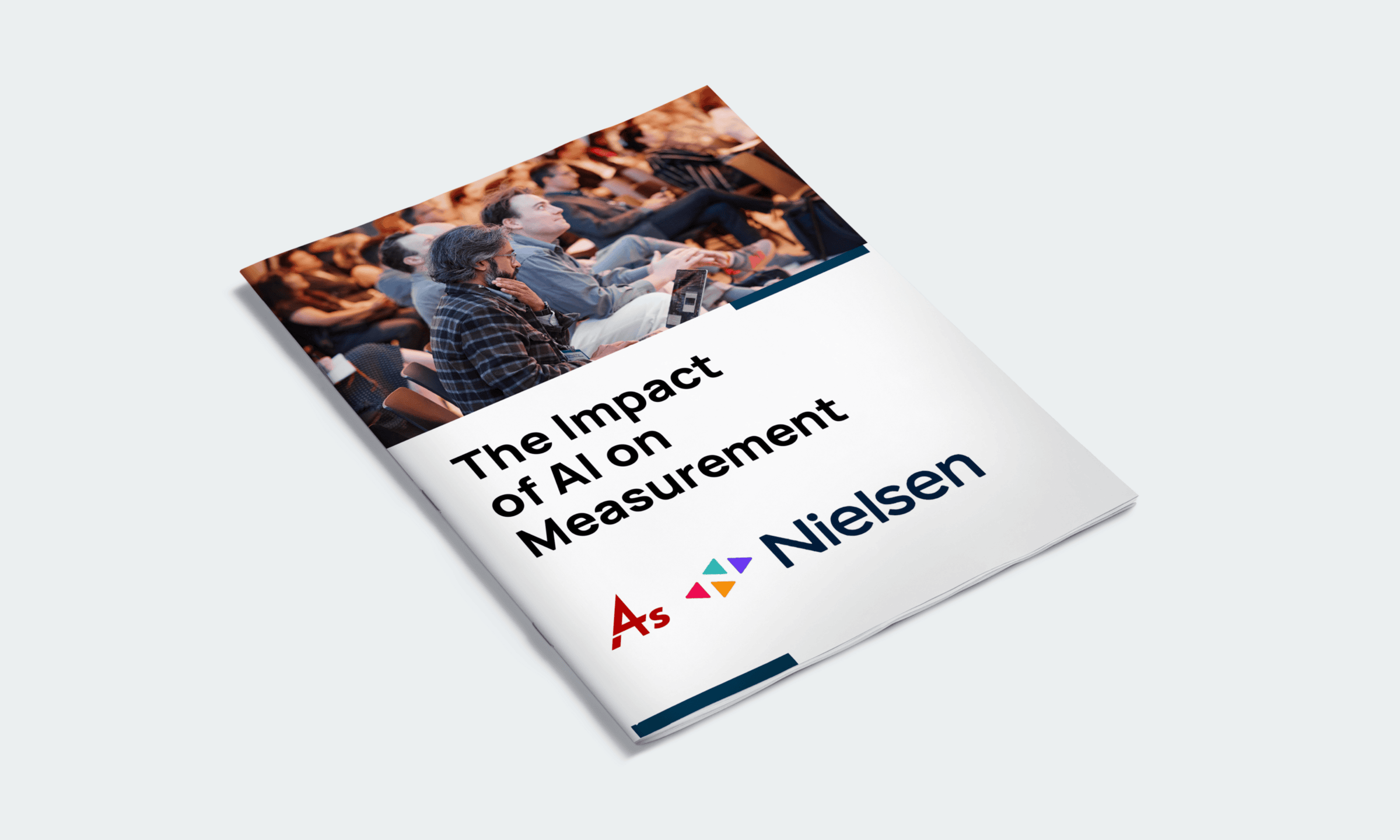
AI is speeding up measurement and that fundamentally changes how we work. As outlined in the 4As and Nielsen white paper “The Impact of AI on Measurement”, the biggest change is not new capability, but the compression of time between data, insight and action.
Measurement has always been about turning data into decisions. The constraint has been time. Time to collect data. Time to harmonize it. Time to understand what it means.
With AI, what used to take days can now happen in minutes. Marketers can identify what is driving performance, adjust campaigns and reallocate spend while it still matters. That speed changes how agencies operate.
It moves measurement from retrospective reporting to active decision-making. It enables teams to respond to current behavior instead of reacting to outdated data.
It also introduces new capabilities. AI can simulate future scenarios, model budget shifts and forecast outcomes with a level of detail that was not practical before. It can identify where returns diminish and where investment should move next. It can support planning through synthetic audiences that allow teams to test ideas without relying on personal data.
These Advances Come with Responsibility.
AI systems are designed to produce clear answers. That clarity can mask uncertainty because measurement requires transparency. It requires an understanding of what is observed, what is modeled and what is simulated. When those distinctions are blurred, confidence can outpace reality.
Speed Comes with Structural Risks.
Data quality remains critical. Poorly defined or inconsistent data leads to faster but less reliable outputs. Model drift can change results without clear visibility. Synthetic audiences can be mistaken for real-world performance if not clearly positioned.
The risk is not the technology itself but how it is applied. To see true and lasting benefit. organizations must build the right foundations.
The Fundamentals of Data
Data must be structured, consistent and connected. Identity, metadata and shared signals are required to link systems and enable accurate outputs. This extends to governance.
AI must operate within defined boundaries. Methodologies must be documented. Outputs must be explainable. Systems must track how results are generated and ensure they remain comparable over time. There must be discipline in how tools are used.
Synthetic Audiences and Responsibility
Synthetic audiences are beneficial for planning and simulation but they do not replace observed measurement. Modeled outputs must be clearly labeled. Decision-making must remain grounded in what can be validated.
AI can accelerate measurement, improve forecasting and enhance decision-making. But it does not remove the need for rigor.
How well agencies and advertisers connect data, methodology and application into a system that produces reliable, actionable insight will be the true measure of success.