The agency business isn’t going away. But the job description is changing fast.
Across the 4As Look Ahead 2026 conversations, leaders from agencies, brands and consultancies all agreed: agencies won’t win by polishing old models or layering AI on top of them. They’ll win by doing work clients genuinely can’t do on their own and proving that value in ways that matter to the business.
That means moving past execution and into something more fundamental.
Human judgment still does the heavy lifting.
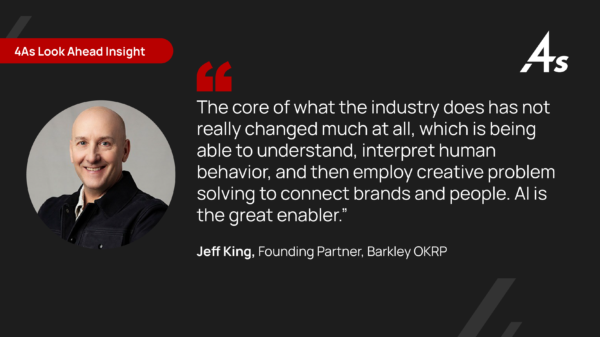
Even with AI accelerating analysis and production, no one we spoke to believes technology replaces the core value of agencies. Jeff King was blunt about it. A pro-technology leader and founding partner of Barkley OKRP, he continues to “bet on insights and creativity.”
AI should take friction out of the work so people can spend more time thinking, not eliminate the thinking itself. Others framed the same risk differently. Push too hard toward systems and performance and everything starts to look the same.
US CEO & Global Brand President, Dentsu Creative Abbey Klaassen warned about brands over-optimizing for algorithms and ending up in a “sea of sameness.” Michael Frohlich, chief marketing and corporate affairs officer at WPP cautioned that agencies risk losing their “heart and soul” if tech becomes the point instead of the enabler.
The takeaway was strongly pro-AI and anti-autopilot.
Clients want partners who can execute, not vendors with better tools.
From the brand side, expectations are getting sharper. Julia Fedor who heads brand marketing operations at United Airlines described agencies as invaluable for the outside-in perspective they bring, seeing what works across categories and translating that thinking into smarter creative and media strategy. But she also made it clear where agencies fall short today.
Too much effort goes into output. Not enough goes into measurement that leadership can actually understand: “two slides,” stripped down to what matters.

Vineet Mehra reinforced that point from a CMO’s seat. Agencies need to stop selling time and start selling outcomes. Creative awards don’t help when a CMO is being evaluated on growth, revenue and efficiency. If agency work doesn’t connect to those metrics, it doesn’t earn its place.
This is where agencies either step up or get sidelined.
In-housing + co-creation
In-housing came up in nearly every conversation and not as a panic point. Executional work is already moving inhouse. But no one believes that makes agencies irrelevant.
CEO of Cheil Agency Network Joe Maglio described a clear split: basic production and some media work will continue to be in-housed, while agencies step into newer, more complex territory like generative search, generative UI and AI-driven experiences. Agencies will often lead with prototypes, show clients what’s possible, then help them implement and evolve those systems over time.
Leaders across the board agreed that agencies are still essential for large, integrated campaigns that require orchestration across channels and partners. The line isn’t agency versus in-house. It’s low-value execution versus high-impact contribution.
The business model has to catch up to the reality.
As execution becomes automated, pricing models built on hours and headcount start to break. Leaders across the interviews acknowledged this shift, even if the path forward isn’t clear yet.
Walrus CEO Frances Webster says the agency is experimenting with compensation tied to usage and licensing to “bring the value back to creative.” The leaders we spoke to pointed to outcomes-based models as the inevitable direction of travel. Jay Pattisall of Forrester offered a cautionary note, however. Cutting headcount and automating work might help margins in the short term, but it becomes a liability if agencies hollow out the very expertise clients rely on.
Rishad Tobaccowala takes it even further, questioning the industry’s nostalgia for traditional apprenticeship models. When AI will handle much of the production work, agencies need to rethink how people are trained, not force the next generation to “pay their dues” doing work machines can already do better.
The POV agencies should act on
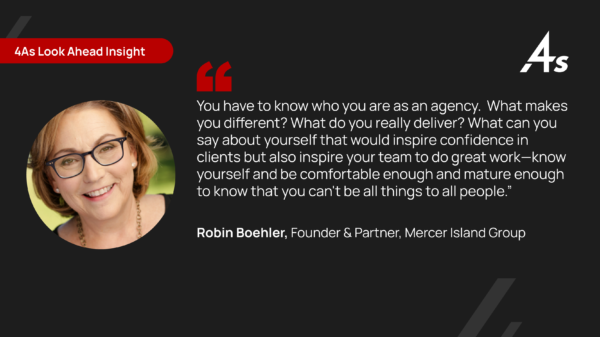
The future agency doesn’t win by pretending to be a platform, a consultancy or a tech company. It wins by being honest about what it does best and building everything else around that strength.
Three moves matter most right now:
Anchor the work in outcomes.
If you can’t tie your contribution to growth, revenue or real business impact, you’re vulnerable.
Use AI to clear space for thinking.
Automate the obvious. Invest the time you get back in insight, creativity and judgment. Choose focus over fear.
Stop trying to be everything.
Specialize, partner aggressively and be clear about your role.
As Rishad put it, agencies need to “focus like crazy and partner like mad.” The ones that do won’t just survive the next cycle. They’ll shape what comes next.
Questions agencies should be thinking about now
As agencies look ahead, the challenge lies in being honest about what role they want to play in it. Start by asking yourself:
- What do we do today that clients truly cannot replicate on their own?
- Today, are we being paid for time and effort, or for impact and outcomes?
- Where does human judgment still matter most in our work and where are we over-investing in execution?
- If AI removes large parts of our current workflow, what value is left and is it strong enough?
- Do our clients understand our point of view and our value as clearly as we think they do?
- Can we explain our impact to a CFO in two slides?
- Are we building specialists and thinkers or just faster producers?
- What would we stop doing tomorrow if we weren’t afraid of losing revenue?
The agencies that answer these questions honestly will be better positioned to lead what comes next. Get deeper insights from the 4As Look Ahead 2026 featuring full-length interviews and 360-degree industry perspectives.