
Author
Mollie Rosen
4As, President - Member Experience
Topic
- Agency Operations / Business Transformation
- Agency structure
- Artificial Intelligence
- Finance
- Utilization and Billability
The economics of the agency business are shifting — fast.
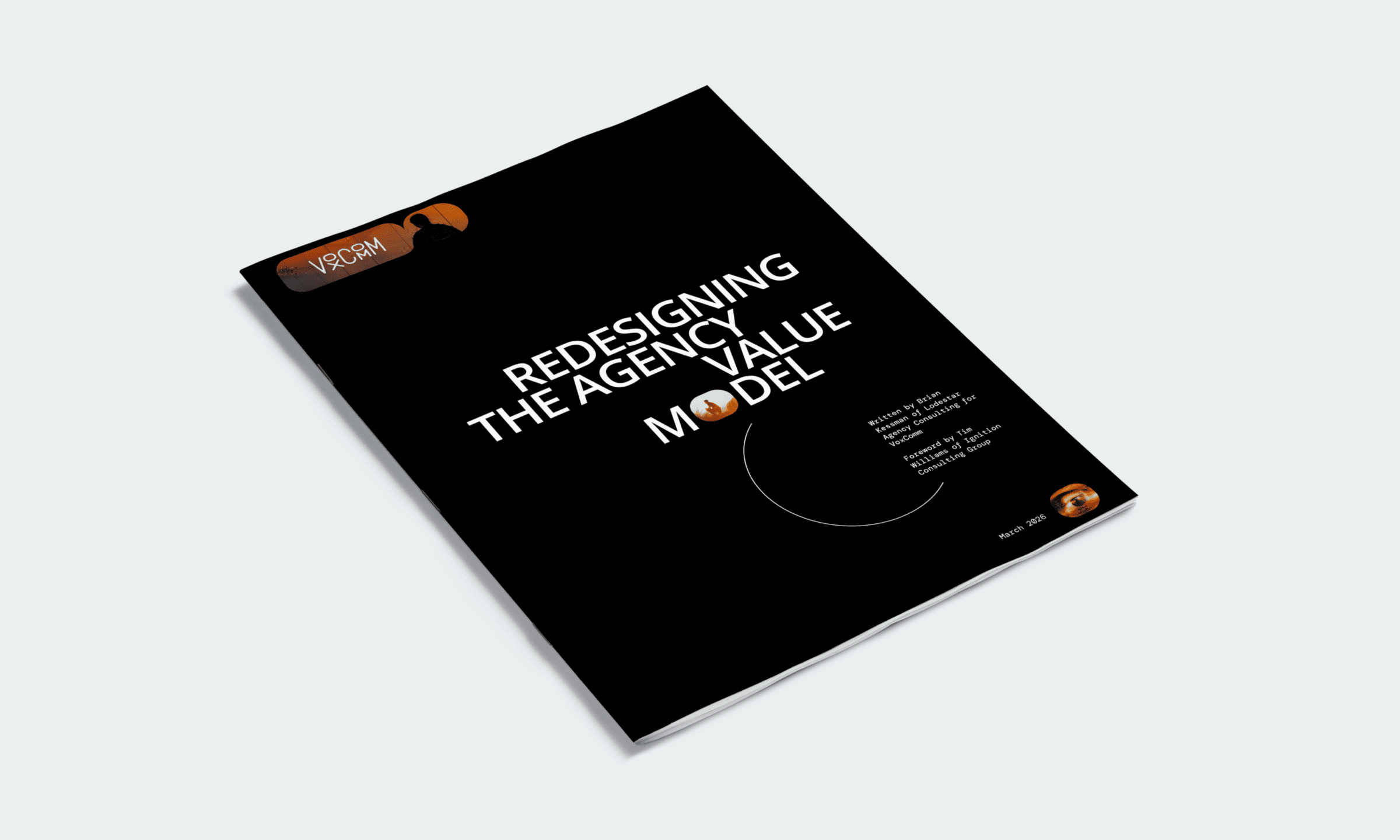
This week, VoxComm, a global agency trade association, and the 4As, along with other industry partners, issued new guidance urging agencies to rethink their business models in response to the accelerating impact of AI. The report, Redesigning the Agency Value Model, argues that incremental pricing adjustments are no longer enough. Agencies must fundamentally redefine how they create — and capture — value.
AI Is Rewriting the Math
For decades, agency revenue has been closely tied to time: hours billed, people staffed, scope expanded. But AI disrupts that equation.
When technology enables work to be done faster, or by fewer people, a time-based model compresses revenue rather than rewarding effectiveness. The traditional service model, built around selling hours, becomes economically fragile in an AI-driven market.
As VoxComm President Charley Stoney puts it,“Incentives shape outcomes. The truth is that AI amplifies the power of solution-based models but erodes the current service-based approach because the economics don’t work in the same way.”
In short: hour-based models reward volume. Outcome-aligned models reward ambition, depth and impact.
From Staffed Services to Productized Solutions
The report calls on agency CEOs, CFOs, and leadership teams to decouple revenue and profit from headcount. Instead of selling effort, agencies should codify their expertise into repeatable, solution-led offerings designed around business outcomes.
The agency of the near future will:
- Sell modular, impact-priced solutions rather than staffing plans
- Turn expertise into repeatable, AI-enabled products
- Replace one-off projects with subscription models combining talent, technology, and measurable outcomes
- Align pricing to value delivered — via fixed, subscription, or performance-based structures
This shift isn’t theoretical. The report features examples from agencies already moving in this direction and agencies that have begun the transition report stronger profitability, improved retention, higher client satisfaction, and better campaign performance.
The Four Stages of Transformation
The report outlines four recurring patterns agencies experience on the journey to a more sustainable model:
- Busy by Design – Revenue tied tightly to effort and hours
- Scaling with Strain – Growth increases complexity and pressure
- Expertly Undervalued – Expertise is strong but under-monetized
- Distinctly Scalable – Revenue decoupled from headcount; pricing aligned with outcomes
The goal: build around expertise and impact rather than activity and inputs.
Pricing Is the Last Step
One of the most important takeaways from the report is that pricing reform alone is insufficient.
Report author Brian Kessman, Founder of Lodestar Agency Consulting, emphasizes that agencies must first redefine what they sell.
“Pricing is the last step in making the transition. Agencies must first redefine what they sell before changing how they price… Vague terms such as ‘full-service’ invite commoditization, while productized solutions can be differentiated and repeatable.”
Repeatable solutions build proof. Proof enables outcome-based pricing. And outcome-based pricing reduces risk for agencies while increasing credibility with clients.
The report opens with a foreword by Tim Williams of Ignition Consulting Group and draws on interviews with leaders who have navigated commercial model transformation firsthand.
Addressing Client Concerns
A key section tackles the questions agency leaders most often raise
- How will clients react if we change the commercial model?
- Where does client pushback typically come from?
- Why do senior clients often respond more positively than expected?
- Why do long-standing clients often push back less than anticipated?
- How are agencies transitioning existing retainer relationships?
Culture Change Is Essential
The transition isn’t just structural — it’s cultural.
Agencies must shift internal focus from tasks to outcomes. Teams must think in terms of business results rather than deliverables. AI becomes an accelerant — not a threat — when incentives align with impact rather than effort.
The message is clear: the agency model built for the industrial era of billable hours will not sustain growth in an AI-powered market.
The opportunity is significant. Agencies that successfully redesign their value models can unlock greater scalability, stronger client partnerships, and improved financial resilience.
For agencies willing to lead the shift, the path forward is not about working more — it’s about redefining what they sell, how they
Related Posts
03/24/2026
AI Is Compressing Time to Insight: How Do We Rethink Opportunities, Risks and Responsibility?


03/19/2026