The 4As Martech Solutions Survey is designed to capture how agencies are using marketing technology tools to drive business outcomes, streamline operations and enhance creative and media workflows. The findings reinforce several of the themes highlighted in the 4As Look Ahead, including the accelerating role of AI, automation and integrated technology in reshaping how agencies operate and deliver value to clients. As the Look Ahead notes, agencies are increasingly re-architecting their models, bringing together data, creativity and technology to build more efficient, tech-enabled organizations. By gathering insights directly from member agencies, the survey highlights the tools and platforms that are most widely adopted, identifies areas where technology supports (or hinders) efficiency and uncovers emerging trends, including the use of AI across creative, strategic and operational functions.
The survey can help 4As members make smarter technology decisions, improve agency performance and stay ahead in an increasingly digital and data-driven landscape. These insights also help shape the 4As’ education and community programming, including the Afternoon Of event series, which are designed to give members practical, practitioner-led guidance on the technologies, tools and workflows transforming agency operations. These curated sessions explore how agencies can apply automation, data and technology to drive smarter execution and measurable results.
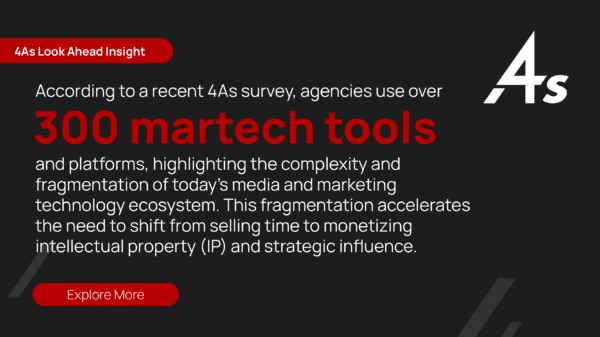
Here’s what we’ve learned:
#1 – Agencies Are Working Smarter, Not Harder
Operational tools keep day-to-day processes running smoothly, while creative and analytics platforms empower teams to turn data into actionable insights and campaigns into results.
You need to have automation in place that creates a baseline of performance for your business and that baseline of performance needs to be achieved through automation that guarantees a steady outcome for your business. – Rocco Baldassarre, Shirofune, 4As Decisions DC 2026 Speaker
Agencies that connect creativity, technology and media to build systems that scale, evolve and perform, are the ones that are going to thrive. Being interoperable by design and not a walled garden is really important. Abbey Klaassen, US CEO and Global Brand President, Dentsu Creative, from the 4As Look Ahead
#2 – AI Is More Than a Buzzword
Generative AI and integrated tools like ChatGPT, MidJourney, Runway AI and Microsoft Copilot are already transforming agency workflows. From speeding up creative production to helping with strategy, reporting and collaboration, AI is enabling teams to focus on higher-value work. Agencies are adopting it smartly, where it accelerates creativity and decision-making, without replacing the human expertise that drives results.
The agencies that will lead in this next era are those that can balance speed with strategy, automation with oversight and innovation with accountability. – Media Works, Ltd., 4As Decisions DC 2026 Attendees
#3 – Opportunities to Raise the Bar
Project management and workflow tools are areas where satisfaction is lower, highlighting opportunities for process improvement and smarter investments. Meanwhile, AI adoption continues to grow, presenting a chance for agencies to stay ahead by embedding these capabilities into everyday operations.
We can’t just rebuild the same complex, costly supply chain with AI. If we do, we’ll end up with the same problems—just with more companies in the middle. – Bill Wise, Mediaocean, 4As Decisions DC 2026 Speaker
In a high-noise, low-trust environment, the connection between brands and people is under pressure. AI is accelerating change, but it is also forcing necessary conversations about privacy, governance and accountability. Technology alone will not rebuild trust. Operating models must evolve with it. The advantage will not come from smarter tools. It will come from clarity, transparency and the ability to turn capability into measurable impact. – Powers of Reasoning, 4As Decisions DC 2026 Attendees

This work gives 4As members and partners a clear view of what’s working, what’s emerging and where efficiencies and innovation can be unlocked. It reinforces the strength of the 4As community: agencies leveraging technology strategically to improve performance, fuel creativity and deliver impact. 4As members are not just keeping up, they’re shaping the future of agency work. By understanding these trends, agencies can make smarter tech decisions, maximize resources and continue delivering exceptional results for clients.
Building on insights from the survey, the 4As has developed a practical decision-making framework to help member agencies move from awareness to action. While the survey illuminated how agencies are investing in and managing their martech stacks, this follow-up resource translates those findings into concrete tools agencies can use immediately.
The decision-making checklists can guide smarter evaluation, rationalization and optimization of martech investments, alongside a clear maturity model that enables agencies to benchmark their current state and define realistic next steps.
Designed to reduce complexity, strengthen governance and align technology with business outcomes, this living resource will evolve alongside future 4As martech research, ensuring agencies can continuously adapt their stacks to meet changing client demands and market realities.
Part I: Martech Decision-Making Checklists
1. Business Alignment Checklist
Before adding, replacing or expanding a martech solution, agencies should be able to answer:
- What business problem are we trying to solve?
- Who is the primary owner (media, analytics, operations, client teams)?
- Is this need client-driven, internally driven or both?
- How will success be measured (efficiency, revenue, performance, insight)?
- Does this support near-term priorities or long-term strategy?
2. Stack Rationalization Checklist
To reduce overlap and complexity:
- Do we already have a tool that performs this function?
- Is functionality duplicated across teams or departments?
- Can this tool integrate with existing platforms (data, identity, reporting)?
- What happens if this tool is removed, who is impacted and how?
- Is the tool actively used by more than one client or team?
3. Data & Integration Checklist
To ensure tools actually work together:
- Does the tool support data portability and interoperability?
- Are APIs, connectors, or exports available and usable?
- Who owns data governance and quality control?
- Can outputs be easily shared across planning, activation and measurement?
- Does the tool align with privacy and compliance requirements?
4. Talent & Workflow Checklist
Technology only delivers value if teams can use it:
- Do we have the skills in-house to deploy and maintain this tool?
- Is training provided, ongoing and role-specific?
- Does this tool fit existing workflows—or require workarounds?
- Are teams incentivized to use it consistently?
- Is ownership clearly defined?
5. ROI & Value Measurement Checklist
To assess performance over time:
- What KPIs define success for this tool?
- Are results tracked consistently across clients or teams?
- Does the tool save time, increase revenue, or improve outcomes?
- Is cost aligned with value delivered?
- When will we formally review performance and make a keep/kill decision?
Part II: Martech Maturity Model
Agencies can use this model to benchmark where they are today and identify realistic next steps.
| Level 1: Ad Hoc | Level 2: Managed | Level 3: Integrated | Level 4: Optimized | Level 5: Adaptive | |
|---|---|---|---|---|---|
| Core Characteristics | Tools added reactively; limited integration; knowledge held by a few individuals; inconsistent usage | Core tools standardized; basic integrations; some governance and training; decisions tied to known needs | Connected data flows across planning, activation, and measurement; clear governance; shared metrics | Stack designed around business outcomes; automation improves efficiency and insight; strong measurement discipline | Continuous evaluation and iteration; AI and automation embedded; high confidence in data quality; stack evolves with the market |
| Governance & Ownership | Little to no formal ownership | Defined owners for core tools | Clear governance across teams | Governance aligned to business outcomes | Governance is continuous and adaptive |
| Data & Integration | Disconnected tools and silos | Partial integrations | Integrated systems and shared data | Optimized, automated data flows | Highly flexible, interoperable ecosystem |
| People & Adoption | Usage varies widely by team | Training exists but uneven | Consistent adoption across teams | High adoption with clear incentives | Teams expect and embrace change |
| Primary Focus / Outcome | Document the stack and define ownership | Improve interoperability and cross-team alignment | Optimize for insight, speed, and scalability | Experiment responsibly with emerging tech | Technology is a competitive advantage, not a cost center |
This framework is intended to be a living resource, updated alongside future 4As martech research.

Amy Pacheco helps advance the conversations shaping the future of media, technology and data across the industry. Working closely with member agencies, she brings insights from across the ecosystem to help agencies navigate change, identify new opportunities and make more informed decisions in an increasingly complex landscape.