Topic
- Artificial Intelligence
As AI accelerates change across the industry, what remains constant? And where should agencies lean in? In this 4As | 4sight conversation, Justin Thomas-Copeland and Joe Maglio explore how agencies can stay grounded in core strengths while embracing new technologies, redefining their role as strategic partners in a rapidly evolving landscape.
Subscribe: Spotify | Amazon | IHeart | RSS
Transcript
Intro (00:00)
Welcome to the Look Ahead podcast series 4As | 4Sight, where we bring together leaders shaping what’s next for our industry. In this conversation, 4As CEO Justin Thomas Copeland and Joe Maglio, CEO of Cheil Agency Network, discuss how agencies can navigate the rapid rise of AI while staying grounded in what drives real value.
Justin Thomas-Copeland (00:29)
I’d love to get your perspective on what you see as the future role of the agency, in a world that is definitely being reshaped by technology and tools and solutions, as well as clients insourcing and doing their own thing. And you know, that surge of AI that changes everything. I’d love just to get your perspective as you think of yourself as, you know — you’re an agency and network leader. What is that future that you see ahead? And how are you sort of navigating to get close to it?
Joe Maglio (00:57)
It’s a good question. I think one thing that I’ve realized and I think this may normalize or maybe just become more consistent over time is right now, depending on what client you’re speaking to, and they can be a big brand, mid-sized brand, it’s more about how they’re set up internally. Some of them need agencies more and others are trying to actually bring more within their own walls, right?
I think for larger brands that are actually set up to do this already because they have the right level of infrastructure and organizational design, they’re trying to bring as much media in-house as possible, right? Because they’re coming to a place where they don’t necessarily need to start paying media commissions or fees. A lot of it they believe they can now do generally on their own. Base level production and what I would call – not even creative, but like that lowest kind of stream of content.
We’re seeing some brands looking to bring that in-house, especially ones that already have in-house creative studios. Then others are like, I need to do more of this stuff faster, but I don’t even have, I’m not even close to having the infrastructure to do it. So I need you guys to actually do more. And I think that’s the part that’s hard to navigate because as we think about like, you know, our plans for 2026 across the agencies and our network, those plans are actually different depending on the client that you’re speaking to in terms of, we almost feel like we have to be able to do everything right now because there’s not really a clear view from our clients as to what they need us and want us to do. The thing that is consistent, I would say, broadly speaking, is speed to market. Meaning most client organizations, because they’re doing so many different things that we never even see or touch, they don’t have the bandwidth that we have to move quickly towards generative UI or even agentic search.
Like to figure out these new areas that are business critical because the general consumer base is adopting these technologies faster than brands are. They need – they really need agencies to do that. And we’ve spoken to across the network, I mean, some of our more sophisticated clients, the better marketers that we work with and they’re not capable or ready to do that. So they’re really looking towards us. We had a meeting and that goes for some of the platform based e-commerce sides of the world that you might see coming from an agency like Barbarian all the way to the creative and content side from, you know, an Iris or a McKinney where our clients seem to be working with smaller, kind of very specific and focused AI companies to develop AI driven kind of baseline work or product focused work. We’re showing them what we’re doing. And we just had a meeting about this a couple of weeks ago and the reaction was, “oh geez, we’ve been working with another partner, a smaller partner that just specializes in this for six months. And what you guys just showed us is so far beyond where they are. I didn’t even realize that you were doing this”. And I think that’s the thing that agencies are set up generally and built to just do stuff faster. And people have the passion and they wanna learn and they just start making things. You know, Cylinder, which is our production company in network, we look at them as like they’re very much a group of makers.
But I think all agencies are becoming makers and we’re just making the things, learning the technology. And as we’re putting this technology, you know, in today’s world in front of clients, they’re saying, “oh wow, okay. You’re so far beyond where I was. But I recognize that the people who are trying to buy my product or service, they’re already expecting that I’m going to be doing this stuff tomorrow. And I’m not even close to that”. So I think that again, that speed to market, the innovation experimentation, I think that’s a big place where people on the client side will need to lean into agencies more than they have before.
I also think there’s the typical and more traditional ways, you know, really smart brand campaigns that are going to move people, that are going to stop you in your scroll, that are going to get you to actually interact and pay attention. That’s a classic – that’s why advertising agencies exist to begin with. I don’t see any of that necessarily going away anytime soon, no matter what Sam Altman or Zuckerberg might want to tell us.
And so I think this is the part where, because I’m an eternal optimist, I look at this as this is actually a great growth area. Agencies aren’t all going to die overnight. There’s actually an opportunity for all of us to even get bigger by providing more services because our core services are largely still needed. And then there’s incremental services that the clients really need us to bring to them.
Justin Thomas-Copeland (06:10)
Yeah. God, you said so many things that were strategically right on point. I mean, it was all on point, but these are the ones that for me, I haven’t heard articulated in quite that way, which I think is fantastic. So thank you. The first thing you spoke about was consumer expectation and the speed of that consumer expectation almost sounding like it’s speeding up brands, right?
And the brand sort of saying, “oh my God, we’ve got a gap. Like the market’s over here, we’re here”. And maybe they thought their in-housing was going to be the answer, but actually they’ve realized they can’t fill that gap, right? Talk to me about the opportunity that you see to fill that gap in terms of, is that about helping the client move closer? So there’s a level of autonomy that even agencies are helping to give clients because, I don’t know, that’s the kind of work that should be in-house or that’s the kind of work that is helping the client develop their IP, like you’re being good partners in this, if you will. Or do you see that as an enduring space of opportunity that if we can get it right and, you know, cost it fairly, set up efficiently, et cetera, et cetera, all givens, that that’s a role long-term, that is a growth path for us. How do you see that? What’s the dynamic in that? Because it could go either way, or maybe other ways.
Joe Maglio (07:37)
Yeah, it definitely can. I think the easy answer is what you just said, which is it’s going to go both ways, right? You’re going to see both things happen. I think to start, much more is going to happen on the agency side. It’s going to have to be brought forward so that the speed to market is accelerated. If you think of generative UI and an e-commerce platform, for example, I think on the agency side, we’re gonna have to bring prototypes to the clients. We’re gonna have to educate them on why they have to think in this generative world. And then I think if they recognize how critical this is for the digital side of their business, they’re gonna say, “okay, well, you guys need to do this for us”. And so I think we’ll come in and start it. In that world, as a partner, I think the hope would ultimately be that, well, now once this is up and running, we’re gonna help educate you on how to maintain this, how to continuously keep this now generative website or app that you have up, so that as consumer behaviors change and adapt, you’re able to make pivots, but we did the big lift for you. That’s potentially there.
When you think of things like generative search, or once you can start just ordering stuff in the ChatGPT interface and you never have to leave, right? I look at that almost as just search in general, paid, owned, the whole thing. There are still many agencies that make a lot of money and provide a lot of value to clients by doing that. That hasn’t come in-house, in part because it’s an ever evolving capability, the algorithms are constantly changing. You have to constantly keep up on everything that’s happening. So something as simple as agentic search, you might want to in-house that, but I feel like that’s something where brands are going to look to agencies to continue to drive that over time, just like for however long brands have looked to agencies for their SEM and SEO.
So it’s going to be a mix, but what it’s probably going to do is you’re going to see brands bring certain capabilities in-house that agencies typically got paid for. But it doesn’t mean the agency is going to go down because I think they’re going to have to add the new stuff on top.
Justin Thomas-Copeland (10:09)
Got it.
Joe Maglio (10:10)
So I think it’s going to be in-housing some of the traditional older stuff, but then filling that bucket with the newer stuff.
Justin Thomas-Copeland (10:18)
Got it, got it. So leveraging the agency’s capability to really be like strategic fillers of that gap, that lag, if you will.
Joe Maglio (10:25)
Yeah.
Justin Thomas-Copeland (10:25)
That makes sense. It kind of brings me on to a thought, which is something that you’ll see in the Look Ahead where we were looking at the agency sort of spectrum. And we were saying, on one end you’ve got agencies now almost kind of resurfacing as purveyors of technology, right? Almost like resellers, solution providers, kind of integrated selling solutions, but really technology focused, right? And at the other end, if you’re going to be really stark, you’ve got agencies as creative business problem solvers. Yes, they have a certain aspect of technology, but it’s kind of the strategic creative problem solving they’re bringing, right?
And then you’ve almost got like an in-between, a third category, which is like the new types of proposition. So innately technology driven, they scale differently, they’re sort of modular networks if they need to be, but they’re essentially very much focused on their specialism, right? So whereas the solution provider or the strategic provider would put their hand in many different types of problems, this sort of new part of the agency landscape is saying, we’re specialists at this thing. This is what we do really, really well. I just wanted to get your take on, A, does that resonate with you and where would you pitch your network, and where do you think the demand and the opportunity will be in those types of — I mean, they’re probably 3,000 variations, but just to bring a different voice to each of those areas. Do you identify with that? Do you see the Cheil network as part of any one of those areas? Or do you think maybe the magic is being able to be a bit of a chameleon as an agency? Like that’s what we’ve been doing for decades — turning our hand to many things. How does that resonate when you hear that?
Joe Maglio (12:20)
So I think you’re 100% right. That is exactly what’s out there. And I think where my head is, is the last comment you made, which is “it’s kind of how this has been happening for decades”. There are significant inflection points in the life cycle of any country, any business, any endeavor that lasts for a long period of time. And so I kind of look at this like, okay, there was advertising pre-internet. Or at least pre — I use that delineation point as high speed broadband. So before high speed internet was broadly accessible, so everyone could actually access things equally. That was one phase and I’m sure there were obviously phases before that. And then suddenly high speed internet became a thing that was broadly accessible. That changed advertising and media forever. I mean, just like every couple of years, all the agencies are going to go out of business. Everyone said everyone’s going to go out of business. Somehow we managed to survive, right. And this is that next kind of high speed internet inflection point in my mind. So to take an overly simplistic view of all of it, I just look at it and say, yeah, there’s going to be full service. There’s going to be technology companies on the agency side that are really powering what clients do because they own and understand the technology. And to your point, there are going to be those specialists. But I think it’s just like a helix and it’s just going to come back together and then something else will happen. And it’s just going to keep going like that because, I mean, back in the day there were search-only agencies.
Justin Thomas-Copeland (12:36)
Right.
Joe Maglio (12:37)
There were social-only agencies, and now there are still some, but by and large, that’s just not enough because you’re looking at a more holistic customer experience. So, you know, I remember when I was at Ogilvy when search really became a big thing that clients were spending a lot of money on. And we had a search agency within the media arm of Ogilvy. And the view at the time was like, no one else knows how to do this. This is like sorcery. Like it’s not even English. Thank God we have these people who know this. Right. And then not long after that, it was like, my God, anyone can do this. And this should just be a strategic part of a full media framework. And I think we’re gonna see a lot of that happen. Barbarian is another example. They’re doing a ton with generative UI and it’s really impressive work, and it’s being presented to clients all across our network from all the different agencies because they’re the only ones doing it. They have a specialty right now.
And that specialty is not going to last 10 years. So I think it’s just, we’re just going to see a lot of this in and out. And so much of our industry just goes back to how is the client structured? What is the view of the CMO, senior marketer or CEO, whoever’s involved in these partnership conversations, and what do they need — or what do they think they need? Like that’s the crazy thing about our industry to me. Right. Like our media agency, Attention Arc — in my career of working with media agencies, and obviously I’m biased in saying this, but I really believe it — they’re the smartest, best media agency with the best underlying technology, with the best view of how to use media to grow a business, to sell things, that I’ve ever been exposed to. So in my head, they should have 100,000 clients, but they obviously don’t, because exactly what they do is maybe not exactly what every client believes they need.
And that’s just the way of the world, right? Like, you know, we’ve both run different agencies over time. And I’m sure you’re sometimes as surprised as I am — sometimes you go in to try to bring something to a client because you’re like, I know they’re going to want this because at my last agency, every client wanted it. And then you’re like, wait, why does no one want it? I don’t get it. Because it’s ultimately so specific.
Justin Thomas-Copeland (16:37)
Right, 100%. And so that gives rise to me thinking about your business model, right? So as you look at things that are more general in terms of solutions and these specialisms being part of that, or as you look at these moments, these windows where generative UI presents an opportunity, right? Do you almost make that a line of business and go into growth mode?
So you’ve got two different business models. You don’t need to choose between the two — I’m channeling my best optimism here. You know what I mean? I’m excited at the opportunity because I’m like, I’m going to play both fields, right. But that’s a business model discussion because you’ve got to be ready to play them. You’ve got to know how to cost them. Maybe the costing is very different. Maybe one — generative UI, because it’s so new — you can move to more of an outcomes-based model, right? Because the client knows there’s value there. You can show what that value is and then you put a price tag on it. And it’s a different approach than your more broad solutions where you’re giving them much more of a breadth of your capability. So it’s exciting. Are you thinking about this internally? Touch on some of these things where you can do things differently — not wanting you to disclose anything you’re not comfortable with, but just in terms of how your business and your leadership team are thinking about the opportunity and how you monetize.
Joe Maglio (18:04)
Yeah, I mean, you just had the conversation that we had a week ago. Because 100%, you know, there’s a number of these things across the different agencies in the network. But if we just stick with generative UI, I do believe this is a point in time. I do believe that what we’ve been doing is much further advanced than what I’ve seen around me. And honestly, we’ve presented to some pretty big clients, CMOs, very experienced people who have said, okay, no one else is really bringing this to me with this level of sophistication and polish and plan to implement. I look at that and I’m like, okay, this is it. This is an approach to 2026. This is gonna be a clear thing that we’re gonna market for ourselves. And all the things you mentioned — we have to figure out how we price it because it is different. What is the level of effort and what do we need from the clients to be able to create something like we just showed them in a prototype that we were able to do on our own without any work structure challenges. So the answer is yes. The hard part is, wait, but that’s not the agency, right? Like that’s actually not Barbarian. It’s just something they’re really good at.
But it’s not like everyone who works at Barbarian does that. And that’s not even what they’re initially known for. So that’s the challenge. I think a lot of agencies are going to run up against this — you start to realize, we’re really good at this thing, we should go tell people. And either the challenge is you’re going to cannibalize the other parts of your business, or no one’s really going to take those meetings because they’re like, oh, but you guys don’t really do that though.
Right? And so some of the AI creative work that McKinney showed in a meeting I referenced earlier — everybody knows McKinney is a creative agency. They’ve been around for close to six decades and that’s what they are. But you don’t naturally think of technology driving creative for McKinney. You think of storytelling and the bigger order of kind of Super Bowl commercials and this and that, right?
Justin Thomas-Copeland (20:02)
I didn’t know you could do that.
Joe Maglio (20:32)
So that’s why this client who knows McKinney really well was so surprised — because they don’t think of technology as inherently part of McKinney’s ecosystem when it comes to developing creative. So it is a challenge. Even though you’ve got this little thing — back to your world of these three areas — if you started here, this is what you’re known for, this is what you’re scaling, people will believe it, and all your examples are that. That makes it a little easier than trying to do this inside a more holistic agency.
Justin Thomas-Copeland (21:11)
Yeah, no, that’s super helpful. I mean, I suppose the other thing that goes with that is talent, right? Like how are your people perceiving all the plays that maybe you as an agency owner are making — you’re looking at growth and opportunity in the moment, but you’ve got a whole world of people behind you who may or may not identify with that, opting in or opting out. Are you finding the talent dynamic of the business more challenging or less challenging in this time? What are you seeing and feeling from a people standpoint? Because there’s so much talk about the tech and we know the tech is great and we love the tech, but you spoke about ideas and storytelling and moving markets through work that has that human touch. How are you finding your people responding to this moment where you can make some business decisions that they may not identify with?
You can pitch up and package your proposition in a way that maybe isn’t fully you, but it is you because you’ve got a system. And then what about what we’ve always done? Are we forgetting that? How is the talent dynamic playing out behind some of these decisions? I’d love to just hear a bit about that.
Joe Maglio (22:26)
You know, it’s much better at this point in the year than I thought it would be. Because in the first six months, generally speaking, the reactions and responses to “we’re going to start doing this in your agency” and “our internal systems are going to function differently because of this” and “this is what clients are asking for, so we’re going to have to respond to it” — the results were mixed in terms of how people individually were reacting. Obviously, you had the conversation — and it probably still continues — of AI is going to take my job. And again, when you have high-profile technology leaders saying no one’s going to need an agency anymore, right? They’re just going to come to us and use our AI capabilities. Those sweeping bold statements are pretty dangerous because they don’t actually encompass the 14,000 agencies in the US. There’s a sub-segment that maybe are going to be in a lot of trouble. So I think a lot of this just became a fear-based narrative. I think one of the phrases of the year just came out as “rage bait.” That is just what we all know gets clicks and gets attention. Some of it’s true. Some of it is just really blown out of proportion. That was all happening in the first six months of the year. I think as we started to really bring AI and all these new technologies into our learning and development agendas across the agencies, people started to realize the value that this would bring to their jobs. I also think, at least in our network, we’re now a year into these conversations being at the forefront.
And we didn’t do some massive layoff across the network because suddenly people’s jobs are irrelevant. We’re upskilling them so their jobs don’t become irrelevant. I think that has now shifted the perspective and how people are reacting and responding. One of the best things we truly did in the last few weeks — which first went into McKinney and then is going to get rolled out across the other agencies — was the AI training that the 4As led.
Justin Thomas-Copeland (24:51)
Okay, great.
Joe Maglio (24:52)
That received such incredibly positive feedback in the post survey. 100% of the people who did the training said it was worth their time, which you don’t often get with any sort of training. But I think that’s where we’re starting to see the shift — okay, I might still be scared, but maybe a little less scared about it taking my job. Maybe still scared about the Terminator situation, but I can’t do anything about that.
It’s not going to take my job outright, but it will make me irrelevant if I don’t learn it. And I think that’s where we’re starting to get some of this uptake. The other thing that has helped is some of the off-the-shelf solutions are just getting better and better. So it’s much easier to bring, whether it’s LLMs or visual models and other AI components — you know, having ChatGPT look at your last five client presentations and tell you what’s different about them. People are starting to realize that this is so helpful in freeing up their minds to think bigger. I think we’re now starting to see momentum across most people in the agencies in our network.
Justin Thomas-Copeland (26:15)
Got it. Now that’s super helpful. And I think as you think about your network, and as you think about upskilling — now people are taking a beat and actually allowing themselves to breathe and see opportunity at a personal level, right?
Because your point about rage bait was real, and it’s like, I’m just going to push back because that’s just not going to be good for me. Right. And now they see — you go through some training and some upskilling and you see that the skills you have are transferable. And suddenly your team has that space. They’ve got that ability to look up and look out with you. I suppose the question I want to end on, or at least one of the last ones, is — so what does that give you in terms of your outlook for the business? Where do you see the real opportunity? Where do you see the pathways for you and your network? How are you bringing your people along for that ride to really understand? There’s conventional wisdom that says, yeah, but all these machines are just gonna automate a bunch of the work that we do and we’re not gonna be doing the high-value stuff. But you just said, if you use these tools in a constructive way, it can give you that space. Does that give you more ambition as a network leader? Does it set your key people different agendas for realizing that ambition? Does it allow you to go into your clients at a different level? Where, strategically, philosophically, and just ambition-wise, are you going to take that? Give us a bit of a window into that.
Joe Maglio (27:57)
Yeah, I think a lot of that comes back to something I said earlier this year in a Drum article — my view of the agency of the future is an operating system. And that’s what I think is actually going to create higher-order opportunity, not drag us down. Because I think it’s the most exciting thing in my career to be able to say that because of this technology, we can build these self-fulfilling operating systems that can take what’s in market, analyze it, help us rethink the media side, help us rethink the content side, even help us build and deploy those assets, track those assets, and then do it all over again and create that virtuous circle. That virtuous circle is something we’ve all talked about, but at least from what I’ve seen, no one has really ever built it in a way where it’s transportable.
I think this allows you to create your own version of an operating system as an agency based on your philosophy, based on how you think consumer demand and consumer experience work. And then you have this portable operating system where more of the base-level tasks are automated. And maybe you don’t get paid as much for those — that’s okay, because you’re going to make up that margin by operating at a higher level. You know, agencies — I say this in every pitch — we are unique because there are two things that we do. We work across so many different brands and categories and products and services that we understand what is happening in the world. I think this is actually a stat that the broader advertising and media industry contributes to something like 25% of the US GDP. That’s because we have our hands in everything. And so we’re moving markets if you really step back and look at it at a macro level. The other thing — in doing that, we know how people work and think and live better than any client ever can. Because we’re combining these data sets and these experiences across industries and categories and age groups and demographics and psychographics. That’s where this operating system is so exciting.
And I really think it’s agencies that need to create these. And then, whatever form it takes — I don’t know if it’s a SaaS model at some point or an outcome-driven model — it’ll change the dynamic of our financials. But that’s the piece that I think allows us to continue to push and help clients go further faster. We’re going to automate some of the stuff we don’t want to necessarily spend all of our time doing, but we’re going to create a system — not just pockets of things, an actual interlocked and interconnected system that can help move a client’s business forward. So that’s the exciting part to me. The other piece, which kind of plays into my optimistic view of the world — this is from Nick Law. He said something earlier this year to the effect that technologists make the things, but it’s creatives who develop the nomenclature for those things.
So one of the examples he used — and I’m probably going to botch this — was the first versions of a camera. They were very utilitarian, they were technology, they were created, they were functional. It wasn’t art until creatives made it art. And so his view, which I share, is that there are technologists who are making these things that we’re all using, but the value of them — where they’re going to actually impact people’s lives and our business — that’s for the creative people to decide. And that has not been decided yet. And so I think that’s the really exciting piece.
Justin Thomas-Copeland (32:03)
Yeah, that’s a lovely thought actually. It’s a really lovely thought. It’s the application of, it’s the adoption of, and it’s bringing the humanity to what those tools or platforms of tech do — you know, a camera becoming art and photography and all those things. Brilliant. Look, one last question then. You’ve got so much knowledge, you’re seeing so much, you’re doing it at scale. It would be remiss of me not to ask you for the one piece of advice that you would give the next generation of agency leaders to best prepare and take advantage of the future of our industry. What’s that piece of advice?
Joe Maglio (32:49)
I mean, what I’m saying right now, number one is don’t panic. Because I think if people go into panic mode, they’re going to make snap decisions that they’re going to regret. You know, the metaverse was a thing for about five minutes, right. But that didn’t stop agencies from coming out as like, we’re now the metaverse agency. And then it just went away because the underlying technology to actually participate broadly in a metaverse environment just didn’t exist, right? And what we’re talking about today with AI is all real, but again, the applications haven’t really been fully understood. And if agency leaders feel like they need to move at the speed that this technology is moving, my firm belief is they’re gonna make mistakes. I think it’s consistency and thoughtfulness and calm right now — not just because the world could use some calm, but as agency leaders, we need to think carefully and not move faster than we need to. I think it all needs to get pulled back a little bit. And having led an agency through COVID is probably what has taught me this. Because that was literally like, the world might actually end.
Justin Thomas-Copeland (34:17)
It was a whole level of existential thinking.
Joe Maglio (34:22)
And that was, you know, we got through it. And that’s obviously a different scenario, but you kind of have to move at your own pace. I think that’s really my number one thing. You can’t ignore all of this — that would be foolish, obviously — but you really do have to move at your own pace and you have to learn and really lean into what the strengths are of the agency or agencies that you’re leading, because not everyone can do everything.
And that’s completely okay. Again, I go back to what we talked about in the beginning — there are going to be pockets for everybody, right? You can’t ignore LLMs and so on because that would be like ignoring the internet when it started. And there were a few who did. But you don’t have to do all the things. I think that’s kind of it — just that view of like, the calm, really thoughtful approach. Don’t worry too much about what’s happening around you. I think that’s the other thing — as agencies, because we’re often very competitive people in a client services industry, we’re constantly out there pushing. But I think we worry too much about what each other’s doing and not enough about what I have right here. This is what I’m going to focus on.
Justin Thomas-Copeland (35:45)
Got it. So calm, understanding there are pockets of opportunity that will continue to manifest, and the value of the agency will endure as it has at many other points. Fantastic advice. Joe, listen, genuinely, it’s always a pleasure to chop it up with you and discuss because I always get the nuggets, and this has been no different. I want to thank you on behalf of everyone who’s going to read some of these insights that you shared. Thank you for being a great member, for being an important member of the National Board. Always a pleasure. So I want to thank you for that. It’s been great talking.
Outro (36:31)
Thank you for tuning in to this episode of the Look Ahead podcast, 4As | 4sight. Be sure to explore more conversations with industry leaders about what’s next for agencies and dive into the Look Ahead on our website at 4As.org.
Related Posts

10/22/2026
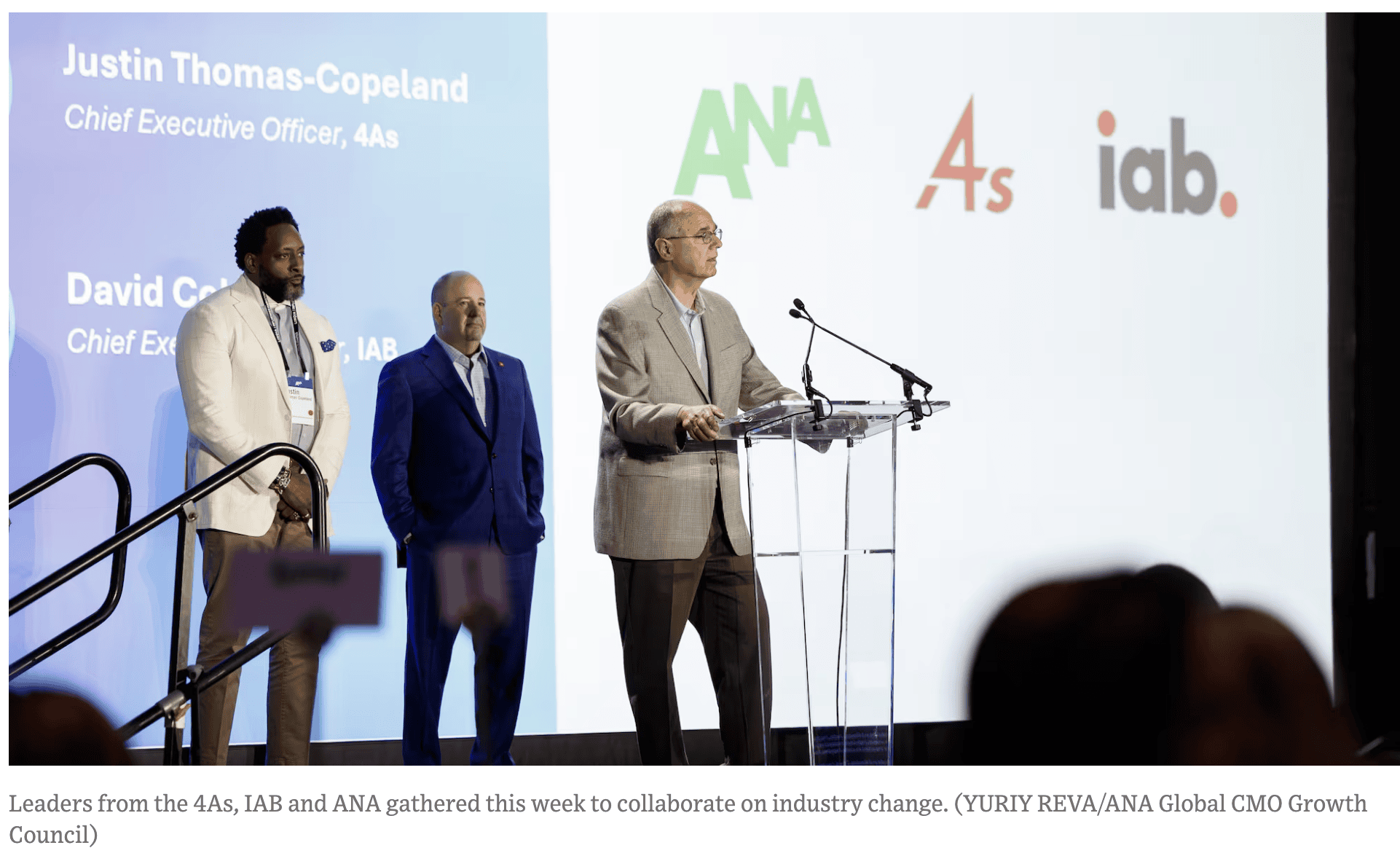
Inside ANA, 4As and IAB’s Closed-Door Talks on AI, talent Development and Ad Measurement

10/06/2026
