Accountability through measurement touches every agency capability. Performance media has dashboards. Digital campaigns have real-time optimization. Internal communications use platform analytics to track behaviors.
Live events also have measurement tools, but too often, they rely on delayed feedback and subjective interpretation. According to Bizzabo’s 2025 State of Events and Industry Benchmarks report, 70% of organizers report difficulty demonstrating ROI for their in-person events. The commitment to live experience is there—80% call it a critical component of organizational success—but the proof isn’t keeping pace.
That gap is helping to drive interest in measuring what’s becoming the new event standard: return on experience, or ROX. For event teams, ROX offers a more meaningful way to evaluate engagement than attendance. ROX measures the real story behind whether your audience was moved, whether the message landed, whether they left feeling something.
Surveys only get us so far
The survey-based event measurement model has been the go-to for decades: pre-event baseline, in-session pulse poll, end-of-day feedback and a post-event follow-up.
Surveys still have a place, but the outputs are too high-level: themes, ratings, aggregate scores. And by the time someone completes a post-event survey, their response may be shaped by travel delays, a bursting inbox, memories of bad food or other peripheral factors.
Surveys give us what people remember feeling. Where they fall short is measuring reaction data—the moment-by-moment signal of what the audience felt as the event unfolded.
No more flying blind
Virtual and hybrid events have spoiled us with data. Real-time chat reactions, poll completion rates, drop-off points, replay engagement—the metrics are built in.
Live events are different. Consider a speaker in front of 500 people in a ballroom. Your client is squinting into the crowd hoping to spot nodding heads. Weeks later, a 3-out-of-5 session rating comes back with no indication of how the event missed the mark.
That raises an important question that keeps me up at night: How can we bring more real-time metrics to live events to understand what’s happening as it happens?
Without moment-by-moment data, the same mistakes get repeated, budgets get defended on anecdotes rather than evidence, and the next event starts from the same blind spot as the last one.
Leveraging facial analysis to clarify event impact
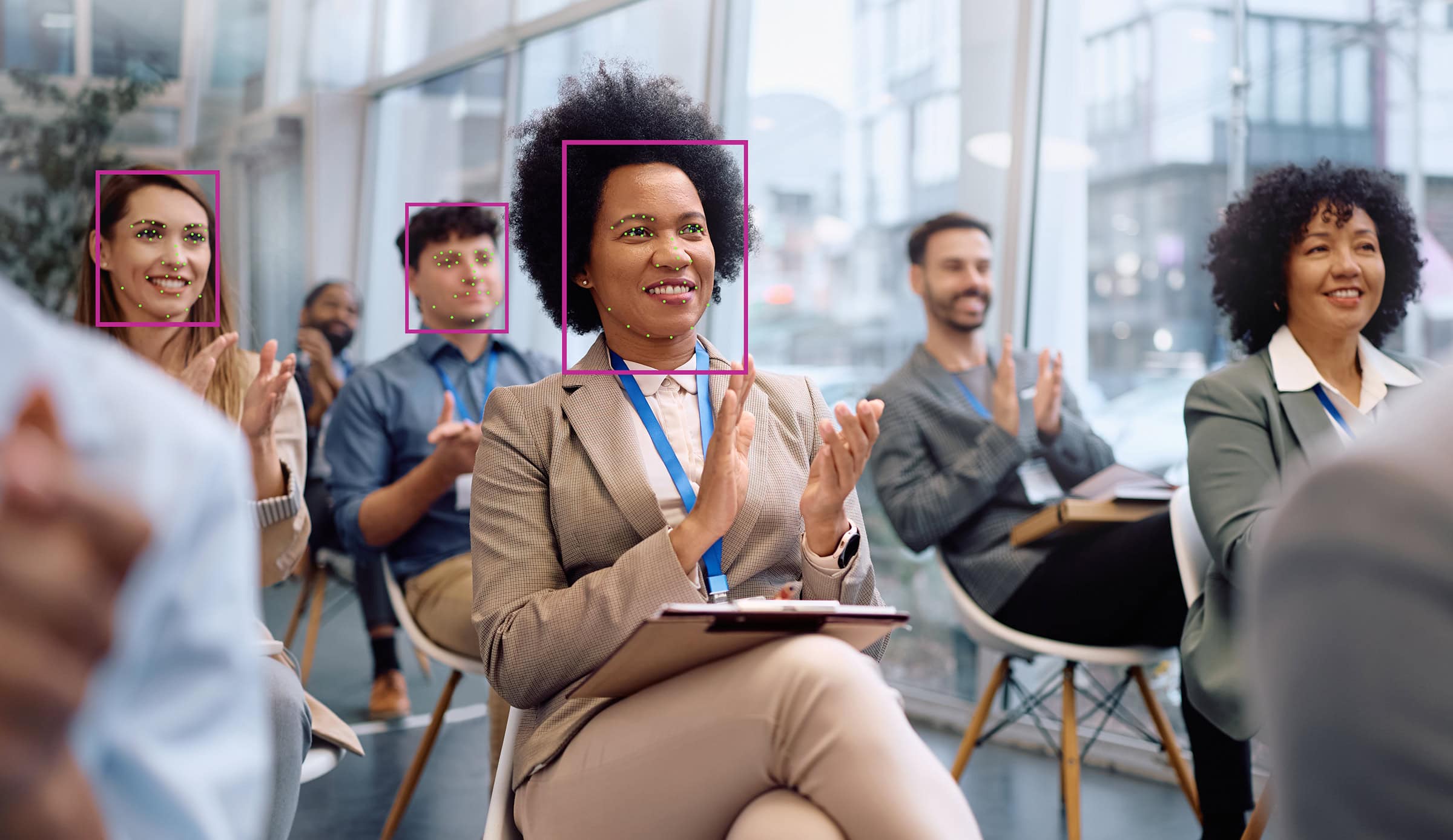
To tackle the issue of measuring live event success in the moment, JPL explored facial analysis technology as a possible solution. It resulted in the development of our Live Events Analytics Platform (LEAP). LEAP is an AI-powered facial analysis platform that captures real-time audience reactions in the room, during the event, as the content unfolds. LEAP delivers on two core metrics:
- Attention: Tracks audience eye direction to generate a continuous view of engagement across a session, showing when focus held and when it drifted.
- Emotional response: Maps facial landmarks to calculate the likelihood of core emotional states (happy, surprised, neutral and frustrated) from multiple faces simultaneously.
Discreet cameras are positioned in the venue. Privacy is fundamental to how the system is designed: Facial data is analyzed locally, and only anonymized numerical data is saved. No faces, no footage. Just reactions.
Analyzing the data around those reactions reveals how content was presented, how it was received and where those two things diverged. A message that was clear on paper but lost the room in delivery is a presentation issue. A section that held attention but produced no emotional response is a content issue. The technology helps distinguish between these two different problems that may have looked the same on a survey. That kind of visibility can inform future content, speaker coaching and overall event strategy.
Facial analysis beyond the ballroom
Ballroom-style events or conferences are an obvious fit for this kind of measurement, but we see the potential use cases for emotion-based metrics going further and are eager to see them applied in more applications, such as:
- Assessing booth engagement at trade shows and expos
- Measuring how stories land in live brand activations
- Improving B2B sales experiences such as manufacturing tours
How agencies can better approach event measurement
We are not recommending that event baseline surveys and in-session pulse polls go away. However, the event and experiential industry must evolve its approach as other agency disciplines have and build a measurement plan around what fits the experience, then layer in emotional behavior signals where possible.
Depending on your client’s required logistics, timelines and budget, an approach could feature any combination of measurement tactics:
Foundational measurement tactics
- Dynamic surveys: Leverage conditional logic to tailor questions by session or attendee role and keep the survey short enough to complete quickly. End with a commitment question: What’s one thing you’ll do differently in the next two weeks?
- In-app Q&A channel: Capture what attendees are thinking, even when there isn’t time to address every question live.
Intermediate measurement tactics
- Live polls and gamification: Use when they naturally fit with the content to increase engagement and generate metrics simultaneously.
- Polling station: Place a single-question prompt near a break area to gather fast feedback with minimal effort.
- Face-to-face pulse polling: Have staff ask one targeted question during breaks for a low-tech way to collect immediate qualitative input.
Advanced measurement tactics
- LEAP: Get a timeline of when engagement climbed and when it dropped, which moments produced emotional response and where the room went flat—without relying on memory or self-reporting.
Defining a new standard of behavioral intelligence in event measurement
Without pushing the boundaries of measurable insight into the experiences we create for clients, agencies risk being viewed as execution support rather than strategic partners. By integrating live event intelligence into their offering, agencies gain the ability to:
- Strengthen RFP responses with differentiated measurement capabilities
- Optimize content during multi-day events
- Level up annual events
- Connect emotional engagement to downstream business outcomes
- Build more compelling ROI and ROX narratives for executive decision-makers
- Justify—and grow—event and experiential budgets
- Elevate their strategic role with clients
The events industry is being held to the same accountability standard as every other marketing discipline. The agencies that meet that standard won’t do it by arguing about the value of live experience; they’ll do it by proving its value. Better measurement justifies the budget for the event that just happened and makes the next event smarter.
Agencies that embrace real-time, emotion-based measurement demonstrate true ROX for their clients.

Jeff Haskett is a Manager of Event Production at JPL with 11 years of experience delivering live, virtual and hybrid events. He blends technical precision with creative thinking to lead complex programs and co-developed LEAP, an AI-powered platform that turns audience emotion into actionable insights.