Home / 4As Blog / The Data Problem No One Wants to Admit
Published 04.28.2026
Author
Amy Pacheco
Director, Media, Tech & Data, 4As
Topic
Media
Media Measurement
Media Planning and Buying
Reporting & Analytics
For years, marketing has operated under a simple assumption: more data leads to better decisions. And in many ways, the industry has delivered. There are more signals, more platforms and more sophisticated tools than ever before, each promising a clearer view of performance and the customer journey.
But despite all of this progress, something isn’t adding up.
Marketers today are operating with unprecedented volumes of data, yet many still lack a complete view of the market. The issue is not access, but visibility. Most systems are built to capture what can be observed: known users, trackable interactions and integrated environments. But everything outside of that remains harder to see, measure or understand.
In a nutshell, we have more data, but not necessarily more perspective.
The Illusion of Completeness
On the surface, dashboards feel comprehensive. They tell detailed stories about customer behavior, campaign performance and channel effectiveness. But those stories are often based on a partial dataset that can over-index on existing customers and known interactions.
What’s missing is just as important as what’s measured.
Audiences outside your CRM
Behaviors that don’t get captured
Markets that aren’t fully represented
Opportunities that haven’t yet been activated
Over time, this creates an illusion of completeness. Organizations optimize within what they can see, without fully accounting for what they can’t. And in a fragmented, privacy-first ecosystem, those blind spots are only growing.
A Different Question
For years, the industry has focused on improving data accuracy: cleaner inputs, better identity resolution and more precise measurement. But accuracy alone doesn’t solve the bigger issue.
The more important question is starting to shift: What are we systematically missing?
That question changes the conversation. It moves the focus away from perfecting a limited view and toward expanding it. It also reflects a broader reality: as privacy regulations tighten and platforms become more closed, the limits of observable data are becoming more structural, not temporary.
From Observation the Known to Understanding the Unseen
Instead of continuing to stitch together fragmented datasets, some organizations are beginning to rethink the approach altogether, by augmenting it.
The shift is subtle, but meaningful:
From observing users → to understanding entire markets
From reporting outcomes → to simulating possibilities
From optimizing known audiences → to exploring unknown ones
This is less about adding another data source and more about introducing a new layer of context that helps marketers see beyond the constraints of their current systems.
Why This Matters
This shift is happening at a critical time. Marketing is navigating:
Increasingly fragmented ecosystems
Stricter privacy expectations
Greater pressure on measurement and ROI
A growing need for forward-looking planning
In that environment, relying only on observed data becomes a limitation. It can drive highly efficient decisions—but within an incomplete frame of reference.
The opportunity now is to move beyond that constraint. To not just optimize what’s visible, but to start accounting for what isn’t.
Continuing the Conversation
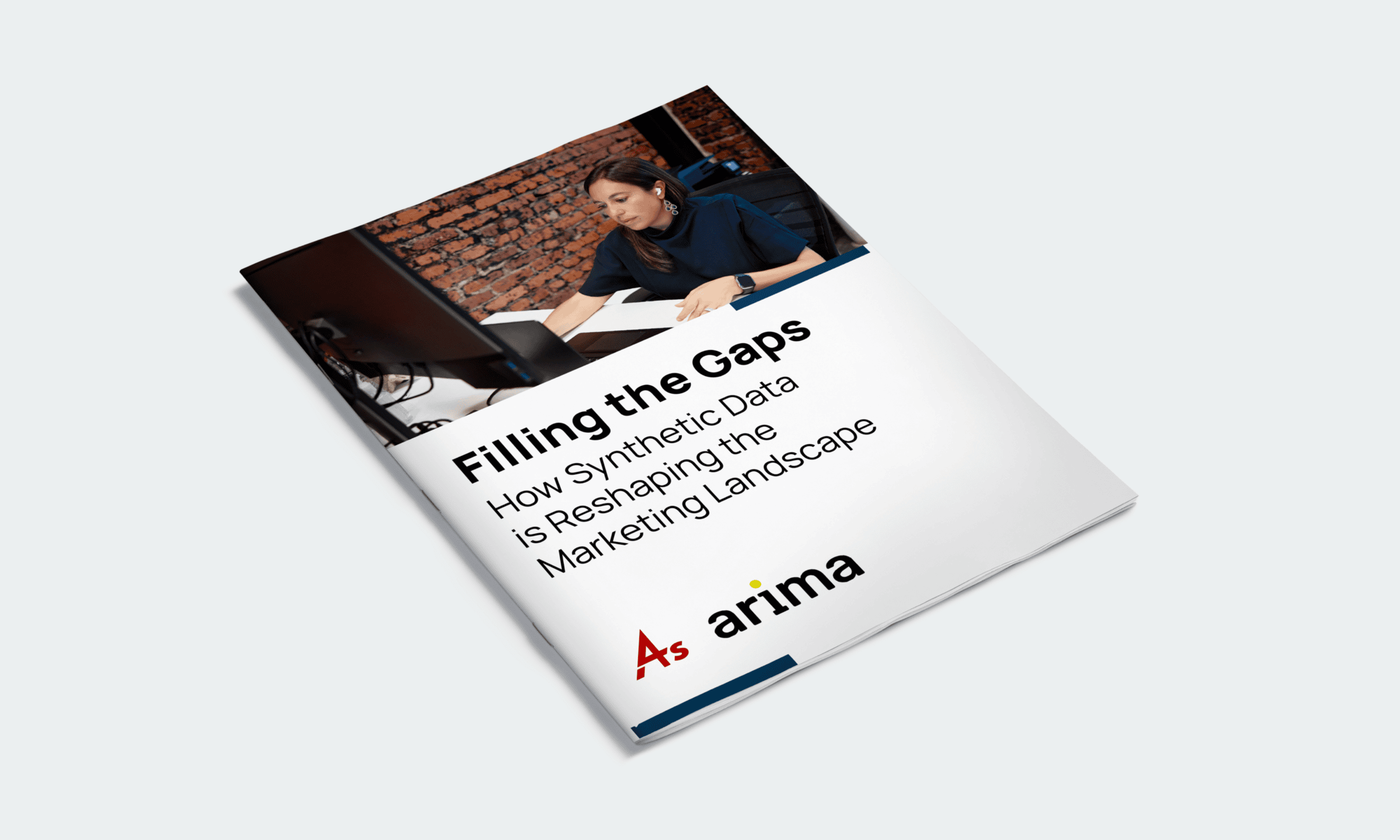
To explore this shift in more depth, we partnered with Arima to examine how synthetic data is beginning to address these structural challenges, helping marketers model broader markets, test scenarios, and strengthen existing data strategies.