
Topic
- Digital
- Digital Advertising
- Format
- Marketing
- Media
- Media Measurement
- Media Planning and Buying
- Out of Home
- Programmatic Advertising
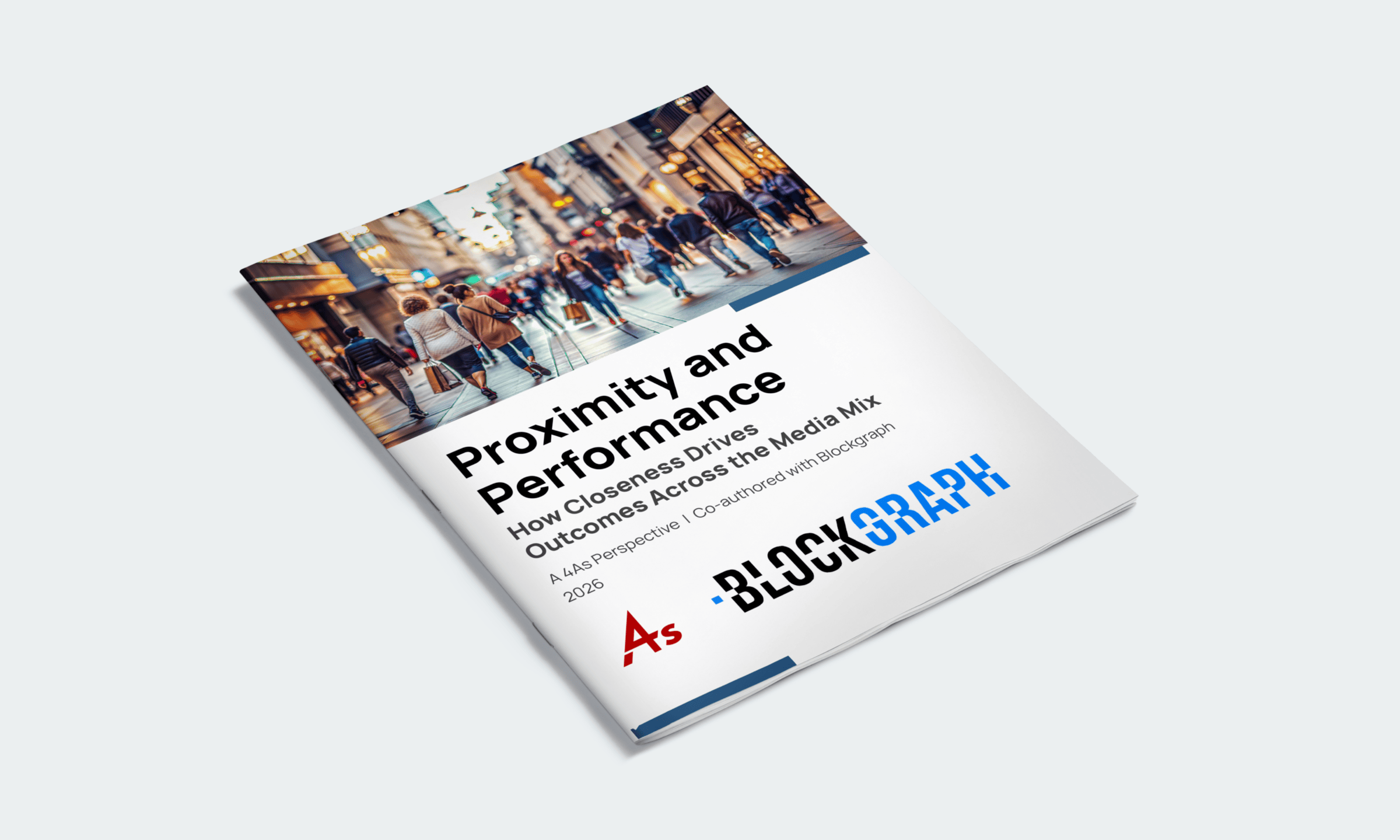
Proximity is one of the most consistent and underutilized drivers of advertising performance. This white paper introduces proximity as a foundational planning principle: the closer a household is to where an outcome can occur, the more likely it is to act. Across channels, categories and purchase cycles, this relationship holds. What’s new is the ability to operationalize this insight at scale. Co-authored by the 4As and Blockgraph, this report outlines how agencies can rethink media planning by prioritizing proximity-qualified households and connecting real-world locations to real-world outcomes with greater precision and impact.
What You’ll Learn Inside
- Why proximity is a universal driver of advertising performance
- How to shift from impression-based planning to outcome-based household targeting
- The distinct role each channel plays in a proximity-informed media mix
- How TV becomes a scalable reach engine for proximity-qualified audiences
- Why household identity is the foundation that makes proximity actionable
- How to define and calibrate effective conversion radii by category
- A practical framework to map locations, score markets and allocate media
- How to measure performance through a proximity lens
Why It Matters
Many media plans optimize for goals tied to reach, cost or demographics rather than real-world likelihood to act. Proximity changes the focus. By concentrating investment on households that are physically closer to conversion, agencies can reduce waste, improve efficiency and drive stronger outcomes. It also reframes the role of channels like TV, digital and OOH into a coordinated full-funnel system built around where performance happens in the real world.
If you’re responsible for media strategy, planning or investment, this paper gives you a more defensible and outcome-driven way to make decisions. You’ll walk away with a clear framework for prioritizing markets, aligning channels and explaining why campaigns work or don’t. For agencies, marketers and media leaders, this is a shift from optimizing for exposure to optimizing for action. Because in a fragmented and privacy-first ecosystem, the most valuable audience is the one closest to conversion.
Related Resources
Member Perks
Dragon Metrics: 4As Member Perk
Search is changing faster than most agency reporting can keep up. Clients still want to see rankings and…
Google Ads Mass Arbitration Opportunity
This meeting addressed an opportunity for 4As member agencies and clients to pursue recovery of structural ad overcharges…
Member Perks
HUMAN Security: 4As Member Perk
HUMAN is a leading cybersecurity company committed to protecting the integrity of the digital world. We ensure that…
