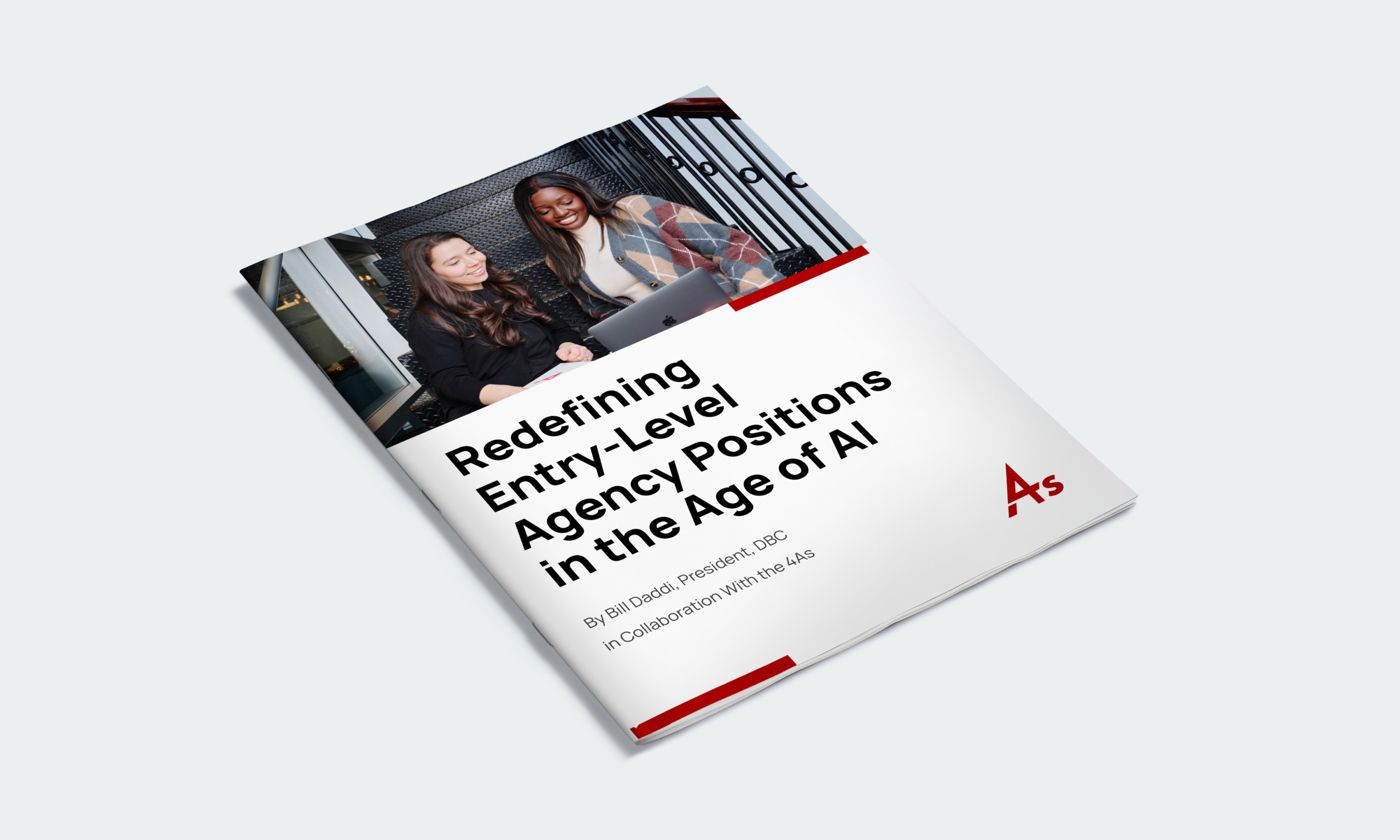
Redefining Entry-Level Agency Positions in the Age of AI
Login Required
Member Only
Home / 4As Blog / Redefining Entry-Level Agency Positions in the Age of AI
Published 06.12.2026
Author
Sylvia Banderas Coffinet
EVP, People, Talent & Upskilling, 4As
Topic
Future of Work/Return-to-Office
Future of the Agency
Future of the Industry
HR/Talent/Inclusion
Talent
We are asking more of talent than ever before. We need people who can adapt faster, think more strategically, work across disciplines and navigate constant change. Yet many of the pathways that develop that talent are getting smaller.
Across advertising, marketing and media, AI is changing how work gets done. Entry-level hiring is slowing in many organizations. Traditional apprenticeship models are becoming harder to sustain. Career paths that once felt relatively straightforward are becoming more complex. At the same time, talent remains the system through which agencies will absorb disruption.
That’s why I’m especially excited to launch this paper alongside my conversation with Bill at the 4As Management Practitioners Forum (MPF), where independent agency leaders come together to openly share the challenges, opportunities and lessons shaping the future of our industry.
The Talent Paradox
Throughout the research and conversations that informed this paper, one theme emerged consistently: agencies are not simply rethinking jobs. They are rethinking how future leaders are developed.
For decades, agencies relied on an apprenticeship model where early-career talent learned through exposure, observation and experience. People developed judgment, confidence and craft by being around great leaders and great work.
Today, that model is under pressure from multiple directions. AI is part of the story. So are hybrid work, consolidation, changing workforce expectations and ongoing economic pressures. The result is a talent paradox. At the very moment agencies need adaptable, strategic talent more than ever, the pipeline that develops that talent is becoming more fragile.
Redefining Entry-Level Talent and the Human Skills That Matter
What gives me optimism is that many agency leaders are not responding by abandoning early-career talent. Instead, they are redefining what entry-level talent can become. The future entry-level employee is increasingly being viewed less as a task executor and more as a strategic contributor.
Agencies are looking for people who can think critically, solve problems, connect disciplines and work effectively alongside AI-enabled tools. They need talent that can bridge strategy, creativity, analytics and technology. Most importantly, they need talent with strong human capabilities.
Judgment. Curiosity. Communication. Adaptability. The ability to understand context and connect ideas. These are the skills that will continue to matter regardless of how technology evolves.
The Question Facing Every Agency
The challenge ahead is ensuring agencies create environments where those skills can develop. That means investing in learning and development. It means creating intentional opportunities for mentorship. It means helping people build community and professional relationships in a workplace that looks very different than it did even a few years ago.
Through programs like I’m New Here and MAIP, we’ve seen firsthand that the desire to learn, connect and grow remains incredibly strong among emerging talent. The need is there. The opportunity is there. The question is whether we are building the systems that allow talent to thrive.
My hope is that this paper serves as both a reflection of where our industry is today and a catalyst for future conversations. Because while technology will continue to evolve, the agencies best positioned for the future will be the ones that continue investing in the people who make adaptation, innovation and growth possible.