I’ve spent much of my career watching smart people waste time solving the wrong problem. Not the creative problem. Not the strategy problem. The research problem. Hours are lost digging through old reports, outdated decks and half-remembered statistics, all in search of one credible answer.
Before I begin almost anything, I ask myself: Is there an easier or better way to do this?
When we need information, we often turn to the person most likely to have the answer. That may shorten our search, but it comes at a cost. It takes time and places an increasing burden on the people whose knowledge is most valuable.
I love helping people, and few things are more rewarding to me than making someone’s life easier. At the 4As, our job is to help members access the information and insights they need as quickly and accurately as possible. But with hundreds of agencies and tens of thousands of members, that level of support is difficult to scale. We also cannot always anticipate what people will need because they often do not know the question until it arises.
We address this through thought leadership, webinars, events and committee meetings. All of these provide value, but they are difficult to scale and rarely deliver an answer at the precise moment someone needs it.
It’s a hidden tax on agency work and every one of us has paid it. The good news is that there is now an easier and better way to do this, AI has made it possible.
According to the 4As-Forrester State of GenAI report, 70% of agencies now use GenAI for research and competitive intel, but 63% name reliability, accuracy and bias as their top GenAI challenge. The average professional loses close to a full workday every week just searching for information, according to the McKinsey Global Institute.
Your team could be spending that time doing better work instead.
For over a century, agencies have turned to the 4As for trusted insights, research and expertise they can’t easily get anywhere else. Questions come in all forms, from across every discipline and level and we wanted a way to get members the answers they need, faster. Because, let’s face it, sometimes you need an answer at 11:05 PM. When your client pitch is at 9:30 AM, a cited answer can’t wait until business hours.
So we decided to build a research agent our members can tap into 24 x 7 x 365.
Meet 4As Intelligence
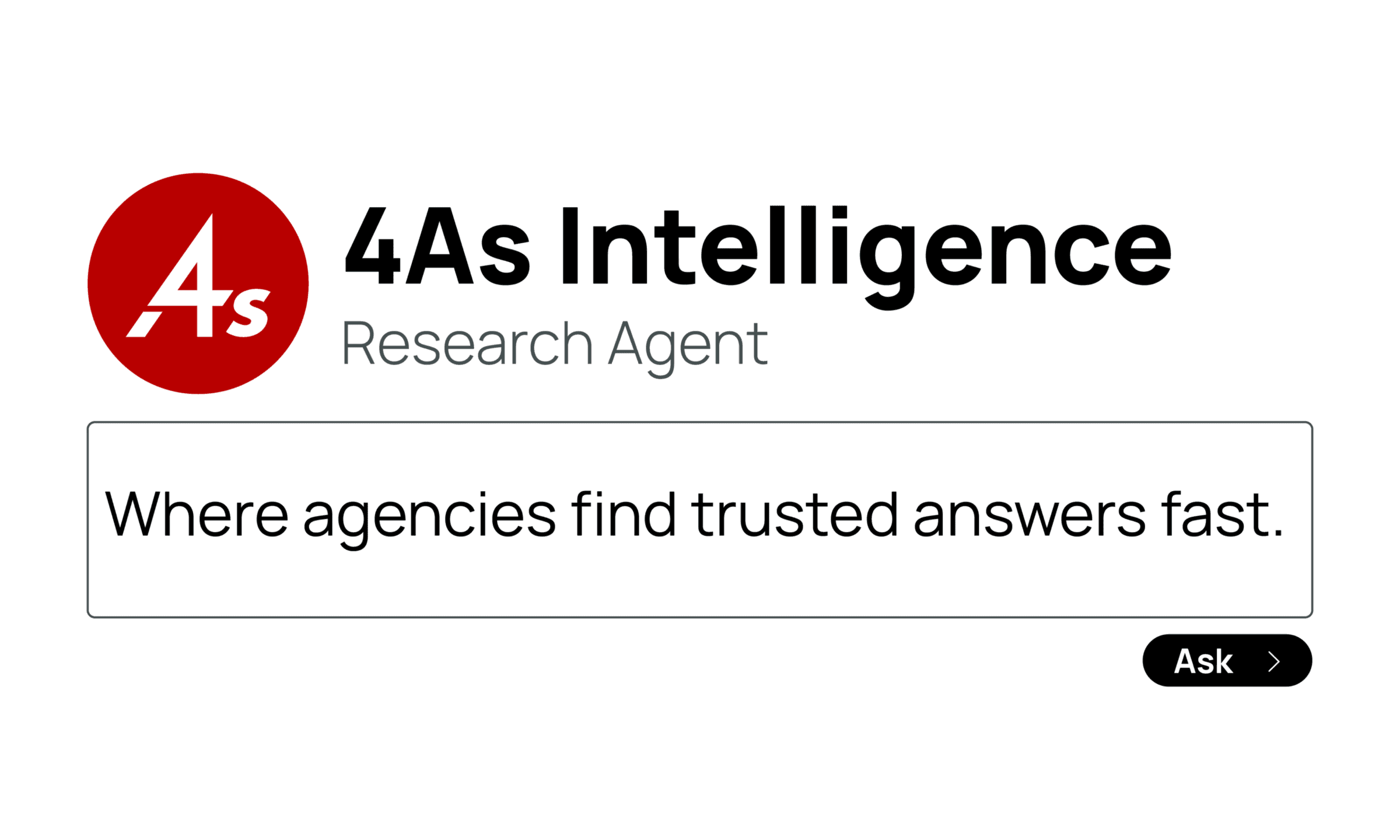
4As Intelligence is a new AI-powered platform built on 4As insights, research and expertise, supplemented by trusted industry partners. Research is the first capability we’ve brought to it.
Through our proprietary Research Agent, you ask a question in plain language and get back a sourced answer pulled from decades of 4As research, expertise and credible industry content. Not just a summary or a generic response, but the actual answer that will help you move forward, backed by the citation.
No more guessing if a stat is current. No more digging through PDFs looking for the one paragraph you need. With 4As Intelligence, you have a direct line to real answers, backed by real sources.
How it works

Why this matters
Phone calls and emails are still essential to how we work with members. But they aren’t always practical the night before a pitch, or when a junior team member needs a starting point. Agency work doesn’t slow down to let you catch up on research.
4As Intelligence is the always-on front door to the 4As knowledge-base. And beyond.
Every answer includes a citation, so you know exactly where it came from. That layer is non-negotiable for us. If we can’t show our work, we’re not delivering the value members expect from the 4As. Every claim ties back to the document or dataset behind it, so you can verify it, dig deeper or pull it straight into your own work.
This isn’t meant to replace the relationships we’ve built with our members over the past century. It’s designed to give members a more efficient path to insights. And when the platform isn’t enough, a direct path to our people too. If a 4As Intelligence analysis doesn’t fully answer the question, or you’d rather talk it through with someone, you can reach the right person on our team. That escalation is already live with our Research team today, and we’re extending it to more areas soon. Technology gets you there faster. People take you deeper.
“Exactly the type of innovation I love seeing out of the 4As: curated, useful, directly taking something off my to-build list.” Mitch Hislop, VP, AI and Technological Innovation, broadhead.
Built for how agencies actually work
Whether you’re two weeks into your first agency job or you’ve been leading teams for twenty years, 4As Intelligence helps you move faster and work with more confidence.
Prepping for a client meeting? Need a benchmark stat in minutes? Double-checking guidance before you hit send? We’ve got you.
A new standard for agency intelligence
We built 4As Intelligence because members deserve answers they can trust and be able to find them before the moment passes.
This is just the beginning.
Research is the first capability we’ve developed and more are on the way, each built around a real agency need. Our goal is an always-on, readily accessible solution that gives members more control and more access to the information they need, exactly when they need it.
Plus, it’s a tool for our own teams too. The same platform that makes our content more accessible to members helps our own team surface the right material, start the right conversations and build deeper relationships across our membership.
If you are member get started here.
If you have data or insights that you think would be a great fit for the platform, let us know. We are always looking to enhance the system’s knowledge.

As SVP of Innovative Technology at the 4As, Kevin gets to do what he loves most: help members, build new products and services and find better ways of doing things. It’s a natural fit for someone who has spent nearly two decades at the intersection of technology, data and media.